

Our Green Claims Policy
As signatories of The Anti-Greenwash Charter, we are committed to upholding the highest standards of responsible marketing and communications practice. The purpose of our Green Claims Policy (GCP) is to define the standards and practices we adopt throughout our organisation to ensure green claims made about our products/services are accurate and substantiated.
This policy applies to all the forms of marketing and communications we use, including television, radio, online marketing (including social media and influencer marketing), direct marketing, shopper marketing, packaging, events, trade/sales, and other professional promotions and communications.
To ensure ongoing compliance, we participate in Campaign Reviews commissioned by the Anti-Greenwash Charter to ensure our marketing and communications align with the standards outlined in this policy.
In addition to this policy, all marketing and communications must at all times comply with the relevant local laws and regulations.
Our Standards
We commit to the standards of practice set out in The Anti-Greenwash Charter, which are as follows:
Transparency
We commit to clear communication of what environmental benefit our product or service offers and won’t conceal or omit information.
Accountability
We substantiate our green claims with accurate and regularly evaluated empirical evidence. We commit to sharing facts, figures and statements that can be checked.
Fairness
We commit to using fair, clear and unambiguous language when providing comparisons with other products or organisations.
Honesty
We will ensure we make specific statements about our organisation’s environmental efforts and that our actions match those promises.
Our Practices
We implement the following practices and procedures to ensure we uphold the aforementioned standards:
– Clearly define the green terms we use
– Provide third-party verified evidence for the claims we make
– Set standards for authentic and accurate visual representation
– Outline a clear editorial process
– Detail the training we provide our employees
– Ensure responsible use of AI in content creation
– Implement an escalation procedure
– Share our approach to stakeholder education
– Explain how we support partners and collaborators
– Commit to regular reviews and effective governance
– Maintain strict legal compliance
Green Terms Glossary
We define the key ‘green’ terms we use to describe our products and services to ensure our claims are clear and transparent:
Natural
Made from naturally occurring materials, including minerals, in their raw, or processed state.
Plant-based
Our binder is linseed oil, made from pressed flax seeds, derived from the plant linum ussitatissimum.
Pigments
Finely ground, mixed and milled mineral pigment in linseed oil suspension.
Plastic free
None of our raw materials are derived from fossil fuels.
Dryers
We use the latest carbon-based dryers, which do not contain zirconium or cobalt.
Oil-based
Natural, linseed-oil made from pressed flax seed.
Low / No VOC
Our paints only contain trace elements of naturally occurring VOC’s. Our Balsam Turpentine is a natural VOC derived from the common pine.
Eco-friendly
Made with materials that do not contribute to climate change or the pollution of our oceans with nano-plastics or microplastics.
Non-toxic
Without ingredients that are classed as hazardous, toxic, carcinogenic or polluting.
If you come across a term you don’t understand and can’t find it on this list, email Michiel Brouns at sales@linseedpaint.com for clarification.
Verified Claims
All verified claims are reviewed annually to ensure continued alignment with updated
standards and regulatory requirements. Any changes to certification status or compliance
levels will be reflected in our marketing and disclosed on our website.
We publish vital, but not mandatory ingredient and raw materials as part of our SDS and TDS on our website.
If you come across a term you don’t understand and can’t find it on this list, email Michiel Brouns at sales@linseedpaint.com for clarification.
Use of Imagery & Colour
In our commitment to transparent and honest communication regarding our sustainability efforts, we recognise the powerful impact of visual representation in shaping perceptions. At the same time, we acknowledge the need for creatives to have the freedom to explore and innovate. Therefore, we uphold the following principles related to the use of imagery and colours in our marketing and communications materials, balanced with appropriate review mechanisms:
• Authentic Imagery: We commit to using genuine and representative images of our products, services, and initiatives, avoiding the use of stock photos that may mislead or give an exaggerated impression of our green efforts.
• Avoidance of Greenwashing through Colours: The use of green or earth tones in materials can evoke feelings of environmental friendliness. We ensure that such colours are used responsibly and are not misleading. If a product or service is represented with green colours, it must have substantiated green credentials to back up such representation.
• Highlighting Actual Efforts: When showcasing our sustainability projects or achievements visually, we will only use images from actual initiatives we have undertaken, avoiding generic or unrelated imagery that may give a false sense of our environmental impact or efforts.
• Transparency in Photo Alteration: Any alterations or edits to photos that may change the reality or context of our green initiatives will be clearly disclosed. This includes photoshopped elements, exaggerated effects, or other changes that might give a misleading impression.
• Cultural & Environmental Sensitivity: We ensure that any imagery used respects the cultural, environmental, and socio-economic context of the regions or communities depicted. This includes avoiding imagery that may be perceived as appropriating or misrepresenting cultural or environmental elements.
• Educative Infographics: Where possible, we will use visual aids such as infographics to simplify and convey complex sustainability data or concepts. These visuals will always be based on substantiated facts and will be designed in a manner that is easy to understand without misrepresenting the
information.
• Creative Flexibility & Review Process: While we encourage creativity and innovation in our visual content, we have processes in place to ensure that all materials are reviewed for accuracy and alignment with our sustainability values. Should any concerns arise, we have a system to highlight issues promptly and make appropriate amendments to maintain integrity in our visual communications.
For any concerns or questions regarding the imagery and colours used in our materials, or if you believe we are not adhering to the standards set out in this section, please contact Michiel Brouns at sales@linseedpaint.com. We appreciate feedback and are dedicated to continuous improvement in our visual communications.
Editorial Processes
We ensure that a member of Senior Management and an editor review every piece of content and any green claims before publication and distribution.
Our content is constantly evaluated. When writing content, our team refers to our list of clearly defined terms and updates the list when using a new term or claim.
We encourage all staff members to challenge our green claims before and after publication.
Staff Training
All staff receive an in-house training session on our GreenClaims Policy and The Anti-Greenwash Charter with the Managing Director, so they fully understand the issues and benefits.
New employees are issued a copy of the Green Claims Policy, which is also available in the office to view at any time, whether in print or digital.
Each year, all employees attend a refresher training session to discuss changes to the policy.
We conduct an annual assessment of our Green Claims training program, incorporating employee feedback to ensure relevance and effectiveness. Updates are made to align with regulatory changes and industry best practice.
The policy is made available to any advertising or marketing agency we employ.
Use of AI
We sometimes utilise AI tools to assist in the creation of content, particularly for data analysis, report generation, and content personalisation. To maintain the integrity of our green claims, all AI-generated content is rigorously reviewed by our human editors before publication.
Our editorial team ensures that the content aligns with our sustainability values, verifies the accuracy of any green claims, and cross checks the use of key terms against our defined list. We also provide transparency by disclosing the use of AI where it has significantly contributed to the creation of content.
Additionally, we conduct regular audits to assess the impact and accuracy of AI-generated content, ensuring continuous alignment with The Anti-Greenwash Charter’s standards.
Escalation Procedure
We recognise that our stakeholders play a crucial role in our efforts to combat greenwashing. Therefore, we commit to responding to any emails regarding our green claims within three working days. Additionally, we regularly conduct user research to understand how our customers interpret our green claims, ensuring they are communicated clearly and effectively.
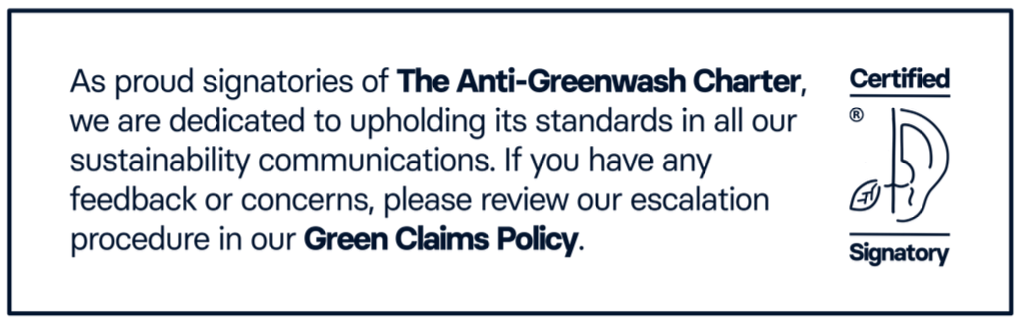
To support this, we include our Certified Signatory Declaration (see below) at the bottom of all relevant campaigns to highlight our commitment to transparency and invite feedback. The declaration
encourages stakeholders to review our Green Claims Policy and outlines how they can escalate concerns for independent review.
If you have any questions or feedback on this policy or our green claims, please email Michiel Brouns at sales@linseedpaint.com for clarification. Alternatively, you can submit any greenwashing concerns directly to The Anti-Greenwash Charter for an independent review here.
Stakeholder Education
Our strategy for stakeholder education involves creating content that informs them about sustainability issues, including the environmental impact of products/services and industry practices. This content is designed to be accessible and engaging, helping to raise awareness and understanding of key environmental issues.
We launch interactive sustainability campaigns that encourage stakeholder participation. These campaigns, such as recycling programs or community clean-up events, aim to actively involve consumers in sustainability efforts, making them a part of the solution.
Partnerships & Collaborations
We are dedicated to promoting sustainability and responsible marketing and communications practice across our network of partners and collaborators.
We actively engage with our partners to encourage alignment with our sustainability values and the principles outlined in this policy. This engagement involves referring The Anti-Greenwash Charter, whilst also sharing knowledge and resources to enhance their understanding and implementation of responsible marketing and communications practice.
We uphold transparency in all our partnerships. Clear communication about the sustainability efforts of our collaborators is essential. We inform our stakeholders about the sustainability credentials of our
partners, reinforcing our commitment to upholding our sustainability goals and public commitments, and encouraging a broader adoption of responsible business practices.
Reviews of Content
We conduct quarterly internal audits of our marketing and communications content to ensure references are accurate and up to date. During these audits, we also review new developments in the industry to identify benchmarking opportunities. Additionally, we undertake an annual review of all ‘static’ content—such as website pages and key documents—to ensure compliance with any updates to the Charter’s standards, changes in relevant regulations, or adjustments to our organisation’s GCP. This ensures our communications remain aligned with the latest expectations for
transparency and responsibility. By incorporating both regular audits and an annual comprehensive review, we ensure our content consistently reflects the highest standards of responsible marketing and communications.
Legal Compliance
Our commitment to legal compliance is unwavering, particularly in the area of green claims. We have established a comprehensive legal compliance framework that includes regular internal audits, ongoing employee training, and collaboration with external legal experts.
Our marketing and communications content is thoroughly reviewed to ensure it complies with all relevant local and international laws, including those related to environmental advertising and data privacy.
We also stay informed about regulatory changes and update our practices accordingly to ensure continuous compliance. Any instances of non-compliance are promptly addressed, and corrective actions are taken to prevent future occurrences. Our legal team works closely with the marketing and communications departments to ensure that all content is both legally sound and aligned with our sustainability commitments.
Governance of this Policy
Our MD is responsible for ensuring that our compliance with this Green Claims Policy is reviewed quarterly. Any non-compliance with this policy will be brought to the attention of the Team, who will decide on further actions and whether the matter should be escalated further.
Any concerns about compliance which cannot be assessed by the MD will be referred to The Anti Greenwash Charter for independent review.
Before entering into new partnerships with third parties, such as suppliers, we share our Green Claims Policy with them to encourage adoption of similar standards.
Campaign Reviews
As a committed signatory of The Anti-Greenwash Charter, we actively engage in an on-going audit process to ensure compliance with our Green Claims Policy. This process involves providing evidence of effective implementation of our practices and procedures during periodic reviews, conducted by a third-party, of a marketing or communications campaign.
These periodic assessments are vital in demonstrating our dedication to upholding responsible marketing and communications practice.
Moreover, we recognise and accept that all audit reports will be appended to our Green Claims Practice (GCP) for public review, ensuring an added layer of transparency and accountability. We are fully aware that any instances of non-compliance may result in the revocation of our certified signatory status, underscoring the importance of continuous compliance and transparency in our operations.
Where We Could Improve
We are committed to continuous improvement in our sustainability practices. Each year, we conduct a thorough assessment of our operations to identify areas where we can further reduce our environmental impact.
Recent evaluations have highlighted opportunities for greater supply chain transparency and provide more training for our team.
To address these areas, we have set specific targets, such as increasing the traceability of our raw materials, and investing in renewable energy.
We regularly review our progress towards these goals and adjust our strategies as needed to ensure we remain at the forefront of sustainable practices.



